Core practice
Korean Sentence Analyzer
Write or paste any Korean sentence and get a word-by-word breakdown with grammar notes, vocabulary cards, a translation, and audio.
Availability
Free
Analyze without an account. A free account adds history and vocabulary saving.
See a full analysis
What it does
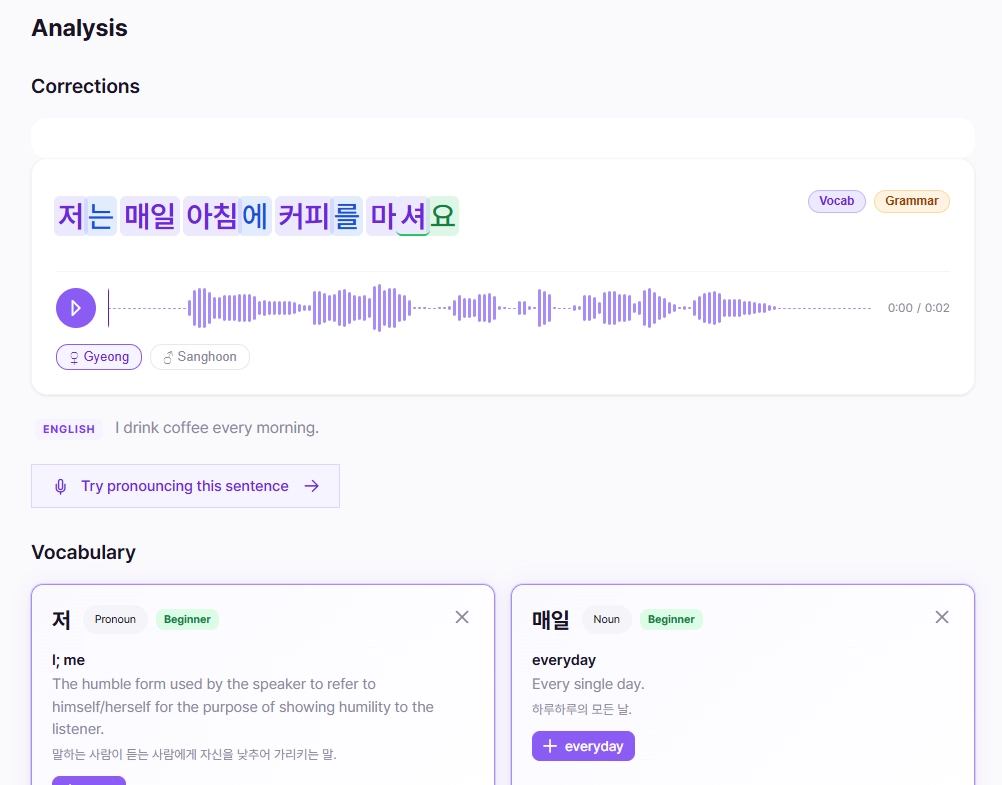
Type or paste Korean text and Elephant takes it apart for you. The sentence is segmented into words, particles, and endings, shown as a color-coded map. Click any highlighted word to open a vocabulary card with definitions and a difficulty level, see the English translation of the whole sentence, and listen to a natural-sounding audio reading.
How the analysis works
Elephant splits the text into meaningful pieces and maps conjugated words back to their dictionary forms. Attached particles and endings appear separately, so you can see the role each part plays.
A translation and natural-sounding synthesized audio complete the breakdown. Results appear progressively, so you can start reading before every part has finished loading.
What you get from each sentence
Every word and grammar point in the breakdown can be added to your study queue with one click. Reviews use FSRS spaced repetition, the family of algorithms created for and used by Anki, to schedule each word when review is likely to be most useful.
With a free account, your analyzed sentences are kept in a personal history, so a sentence you puzzled over last week is easy to revisit. You can also share any analysis by link. The demo below works without an account.
What an analysis looks like
Paste the sentence you're stuck on
Free, no account needed. The full breakdown streams in right here.
Tip: press Cmd/Ctrl + Enter to analyze quickly.
Analyzed sentences are added to Elephant's public example corpus. Don't enter personal or sensitive information.
0 / 100
We could not analyze this sentence
Vocabulary
Grammar
Questions about Sentence Analysis
Do I need an account to use the analyzer? ▼
Can it handle conjugated verbs and contractions? ▼
How is this different from a translator? ▼
Are the sentences I analyze private? ▼
More ways to practice
Korean Translation Practice Online
Translate English prompts into Korean and get corrections that explain every mistake instead of just marking it wrong.
Korean Pronunciation Practice App
Listen to natural-sounding Korean audio, record yourself, receive word-level scoring, and try again.
Korean Example Sentence Search
Pick the grammar features and vocabulary you are studying and get matching corpus sentences, each linked to a full word-by-word breakdown.
Korean Word Scramble Practice
Put shuffled Korean word chunks into a grammatical sentence and learn how flexible Korean word order really is.
Korean Listening Practice
Train your ear with single sentences, dictation, whole passages, and multi-speaker conversations.
Write a Sentence in Korean
Turn vocabulary you have reviewed into Korean you can produce by writing an original sentence around one word.
Korean Number Practice
Build both Korean number systems through guided paths, then drill the everyday concepts that need more work.
Adaptive Korean Grammar Practice
Practice grammar points you have studied with targeted recognition and production tasks that adapt to your recent mistakes.
Korean Reading Practice
Read complete Korean passages, answer comprehension questions, rebuild their order, and place a missing sentence.
Save the words you find
Analyzing is free with no account. Sign up free to send any word from a breakdown into your spaced repetition queue and keep a history of every sentence you analyze.
Sign up free